
About
The University of Leeds has a vibrant and eclectic group of researchers involved in biofilm research. We cover many different research areas from dental biofilms to engineered coatings on surgical scrubs and everything in-between. We cover nearly every Faculty in the University and have multiple collaborations across the world. The Leeds Biofilm Network was created to bring all these people, their groups, their expertise and their ideas together in one place. Many of us were associated with the National Biofilms Innovation Centre (National Biofilms Innovation Centre), but we lacked real knowledge of who was doing what within our own institution, the University of Leeds. To join the Network, get in touch, and we look forward to seeing you at one of our research events!
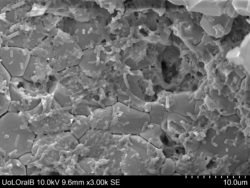
Oral Biofilm on Hydroxyapatite, a dental model.
Leeds has an extensive multidisciplinary community working with oral biofilms. Our work in this area crosses multiple length scales and integrates many disciplines and is broadly descried by five themes:
Generation of biofilms: We have a number of diverse experimentally-based models to culture stable biofilms from simple mono- to multi-species biofilms, to systems that reflect the full complexity of natural biofilms of the mouth. We are able to support growth of biofilms in static or flow systems, on plastic and metal surfaces, hydroxyapatite coated materials, radicular and/or coronal human dentin discs and within uniquely designed and fabricated microfluidic devices. We are also able to design and manufacture automated devices facilitating high throughput production of biofilms. Natural oral biofilms are generated in situ using enamel devices attached to the teeth of volunteers.
Characterisation of biofilms: Multiple techniques are available to us, with analyses focused on composition (culture, metagenomics, transcriptomics), architecture (TEM, SEM, CLSM), mechanical characterisation of biofilm by rheology, AFM and (in vitro/ex-vivo) tribological methodologies enabling us to probe the biofilm as a whole, the biofilm- surface or to specifically probe the proteins within. We can probe biofilm components by Raman spectroscopy and mass spectrometry. Analyses of biofilm substrates such as enamel is possible via microhardness and more advanced analyses using micro Computerised Tomography (CT) and other biophysics expertise available in the group.
Disruption and inhibition of biofilms: Novel model systems aimed at the disruption of biofilms include the use of microbubbles, ultrasound and cold atmospheric plasma (CAP). Furthermore, we have developed therapeutics to combat biofilms including novel self-assembling peptide drug delivery scaffolds, anti-microbial peptides (AMPs), chitosan coated liposomes loaded with quorum sensing inhibitors or antimicrobial peptides, and silver loaded core-shell AuNP polymers.

Modelling Oral Biofilms on Dental Implants
In silico mathematical and in-vitro fluid dynamic modelling: Agent-based mathematical modelling is used to investigate factors associated with oral biofilm dysbiosis and inform experimental design. We also model in silico specific drug-biofilm interactions at the atomic scale and the mechanisms of biofilm disruption involved. We perform microfluidic in-situ quantitative optical analyses of early stage deposition and biofilm formation by model pathogenic strains under various hydrodynamic conditions. These analyses highlight the role of single and multi-phase flows on the formation, deformation and disruption of model biofilms.
Applied research models and therapeutics: Biofilm-mammalian cell co-culture is employed to determine influences of biofilms on host responses and wound healing and the interaction with potential therapeutic agents. We assess the efficacy of medical devices aimed at disrupting biofilms within in the oral environment including expertise in the use of the Calgary device and three dimensional bi-layered tissue engineered model (currently in applied to model the periodontium) that can be used to investigate biofilms, antimicrobials and multiple host cellular responses. Leeds hosts a Musculoskeletal Tissue Bank, facilitating supplies of human teeth and associated tissues for use in our models and applied studies